

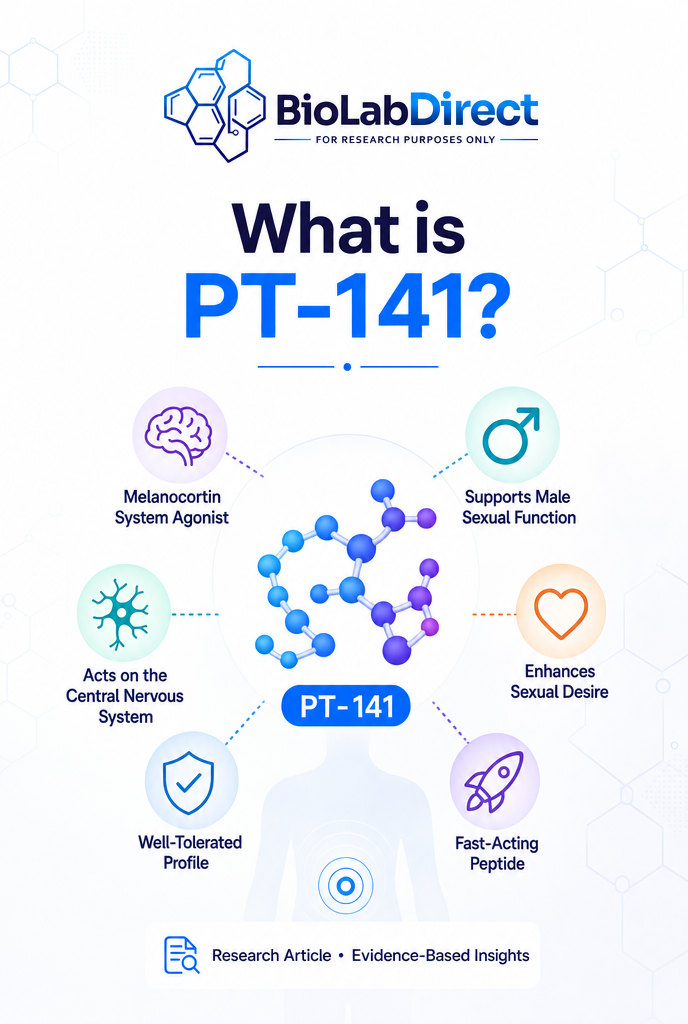
PT-141 is the developmental name for bremelanotide, a prescription peptide medication that acts on the melanocortin receptor system. In the United States, the FDA-approved formulation is sold as Vyleesi and is indicated for acquired, generalized hypoactive sexual desire disorder—commonly abbreviated as HSDD—in certain premenopausal women.
Unlike medications that mainly affect blood flow, PT-141 acts within the central nervous system. Its effects are associated with brain pathways involved in sexual desire, although the precise mechanism through which bremelanotide improves HSDD remains unknown.
Understanding HSDD
Hypoactive sexual desire disorder involves persistently low sexual desire that causes significant personal distress or interpersonal difficulty. For bremelanotide’s approved use, the condition must be acquired, meaning it developed after a period without problems involving sexual desire, and generalized, meaning it occurs regardless of the situation, stimulation, or sexual partner.
The approved indication excludes low desire caused by another medical or psychiatric condition, relationship problems, or the effects of a medication or substance. A qualified healthcare professional should therefore evaluate possible contributing factors before considering treatment.
Bremelanotide is not FDA-approved for postmenopausal women, men, children, or general sexual-performance enhancement.
How Does PT-141 Work?
Bremelanotide is a synthetic cyclic peptide and melanocortin receptor agonist. It activates several melanocortin receptor subtypes, with activity at the MC1 and MC4 receptors considered especially relevant at therapeutic doses. MC4 receptors are found throughout the central nervous system and are believed to participate in pathways associated with motivation, arousal, and sexual behavior.
This central action differs from phosphodiesterase type 5 inhibitors, such as sildenafil, which primarily support erectile function by increasing blood flow. PT-141 should therefore not be treated as a direct substitute for those medications.
Activation of MC1 receptors also helps explain one of bremelanotide’s notable adverse effects: localized darkening of the skin or mucous membranes.
What Does the Clinical Evidence Show?
Bremelanotide was evaluated in two randomized, double-blind, placebo-controlled Phase 3 studies known as the RECONNECT trials. Premenopausal women with acquired, generalized HSDD used a 1.75-milligram subcutaneous injection as needed before anticipated sexual activity.
Across both studies, bremelanotide produced statistically significant improvements in measured sexual desire and reductions in distress related to low desire compared with placebo. However, FDA labeling reports no significant difference between the groups in the number of satisfying sexual events, which was a secondary study endpoint.
This distinction is important. Some patients may experience improved desire or less distress without necessarily experiencing greater sexual frequency or satisfaction.
A 52-week open-label extension reported sustained symptom improvements among participating patients and did not identify new safety signals. Nevertheless, individual response and tolerability varied, and longer-term evidence remains more limited than the evidence available for many older medications.
How Is Bremelanotide Administered?
The FDA-approved product is supplied as a single-dose autoinjector containing 1.75 milligrams of bremelanotide in 0.3 milliliters of solution. It is injected under the skin of the abdomen or thigh at least 45 minutes before anticipated sexual activity.
Patients should not use more than one dose within 24 hours, and administering more than eight doses per month is not recommended. More frequent dosing may increase the risk of blood-pressure effects and focal hyperpigmentation.
The prescribing information also advises stopping treatment after eight weeks when the patient does not report meaningful symptom improvement. Administration should occur only after evaluation, prescribing, and injection training by a qualified healthcare professional.
Side Effects, Contraindications, and Interactions
Nausea is the most frequently reported adverse effect. In pooled Phase 3 data, nausea occurred in 40% of bremelanotide-treated participants, compared with approximately 1% of those receiving placebo. Other commonly reported effects included flushing, injection-site reactions, headache, vomiting, fatigue, dizziness, tingling, hot flushes, coughing, and nasal congestion.
Bremelanotide temporarily increases blood pressure and may reduce heart rate after each dose. It is contraindicated in people with uncontrolled hypertension or known cardiovascular disease. A healthcare professional should assess cardiovascular risk and ensure that blood pressure is adequately controlled before treatment.
Focal hyperpigmentation may occur on areas such as the face, gums, and breasts. The risk appears to increase with frequent dosing and may be greater in people with darker skin tones. In some cases, the discoloration may not fully resolve after treatment is discontinued.
Bremelanotide can also slow gastric emptying and alter the absorption of certain oral medications. Of particular concern, it may significantly reduce exposure to orally administered naltrexone, potentially compromising treatment for alcohol or opioid use disorder.
The prescribing information recommends effective contraception during treatment and discontinuation if pregnancy is suspected because the available human pregnancy data are limited and animal studies have identified potential fetal risks.
This article is for educational purposes and is not a substitute for professional medical advice, diagnosis, or treatment.
References
- DailyMed: Vyleesi—Bremelanotide Prescribing Information
- Kingsberg et al.: Bremelanotide for the Treatment of Hypoactive Sexual Desire Disorder—Two Phase 3 Trials
- Simon et al.: Long-Term Safety and Efficacy of Bremelanotide
- Molinoff et al.: PT-141, a Melanocortin Agonist for the Treatment of Sexual Dysfunction
- U.S. Food and Drug Administration: Understanding the Risks of Compounded Drugs