

BPC-157 has become one of the most widely discussed experimental peptides in fitness, recovery, sports medicine, and longevity communities. It is frequently promoted online as a compound that may accelerate the healing of tendons, ligaments, muscles, joints, and the digestive system.
Much of this interest comes from encouraging laboratory and animal research. However, BPC-157 remains an investigational substance. It has not been established as a safe and effective treatment through large, well-controlled human clinical trials, and it is not an FDA-approved medication.
Understanding BPC-157 therefore requires separating its scientific potential from the claims commonly made about products sold online.
What Does BPC-157 Mean?
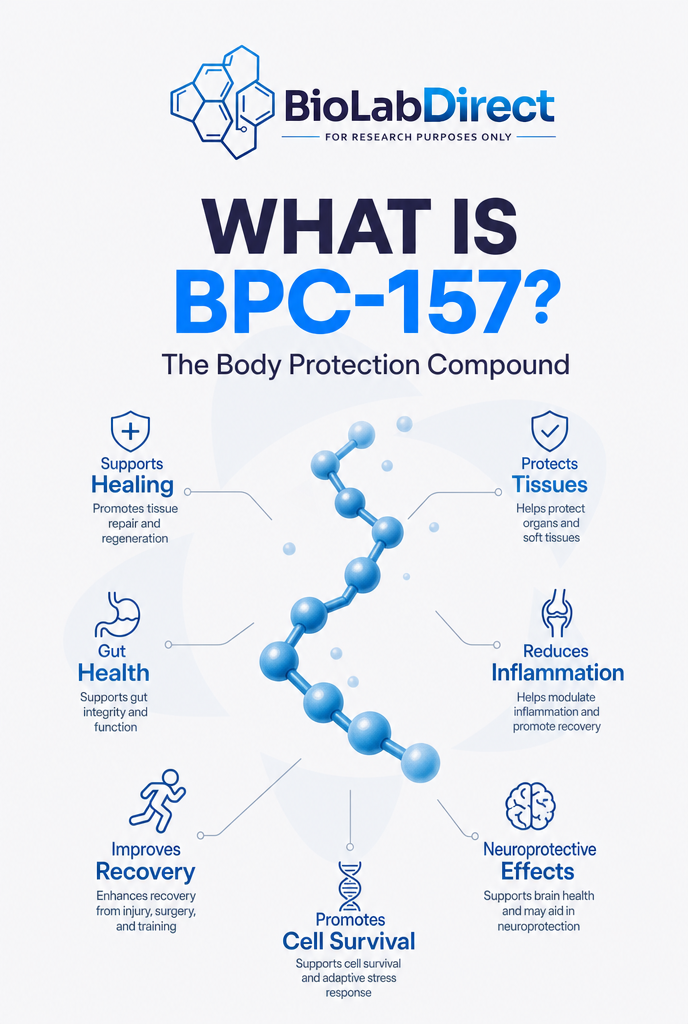
BPC-157 is commonly described as Body Protection Compound-157. It is a synthetic peptide made from a sequence of 15 amino acids, which is why researchers also refer to it as a pentadecapeptide.
The sequence was developed from research involving a protective compound associated with human gastric juice. Although BPC-157 is often marketed as a “natural peptide,” the products discussed in research and sold commercially are synthetically manufactured versions of the peptide sequence.
BPC-157 is not a steroid, anabolic hormone, growth hormone, or traditional pain medication. Instead, it is being studied as a signaling peptide that may interact with several biological systems involved in inflammation, circulation, cellular migration, and tissue repair.
How Is BPC-157 Believed to Work?
BPC-157 does not appear to work through one simple pathway. Preclinical research suggests that it may interact with several biological processes involved in tissue protection and repair.
The proposed mechanisms remain under investigation and should not be treated as clinically confirmed effects in humans.
Blood-Vessel Formation and Circulation
One of the most frequently discussed proposed effects of BPC-157 is its influence on angiogenesis, the process through which new blood vessels form.
Blood vessels deliver oxygen, nutrients, immune cells, and other materials needed during tissue repair. Animal and laboratory studies suggest BPC-157 may interact with vascular endothelial growth factor, or VEGF, as well as nitric-oxide and focal-adhesion-kinase pathways involved in circulation and blood-vessel activity.
This has led researchers to investigate whether the peptide could improve blood flow around injured tissue. However, encouraging evidence from laboratory models does not establish how reliably, safely, or significantly this occurs in humans.
Fibroblast Activity and Collagen
Fibroblasts are cells involved in producing collagen and building connective tissue. Collagen is a major structural component of tendons, ligaments, skin, cartilage, and other tissues.
Experimental research suggests that BPC-157 may influence fibroblast movement, survival, and activity. These effects could theoretically support the repair of connective tissue after an injury.
This proposed action is one reason BPC-157 has become especially popular among people dealing with tendon or ligament problems.
Inflammation
BPC-157 has demonstrated anti-inflammatory or inflammation-modulating effects in several preclinical studies.
Inflammation is a normal part of healing, but excessive or persistent inflammation may contribute to pain and delayed recovery. Researchers are examining whether BPC-157 affects inflammatory signals without completely preventing the inflammation required for normal tissue repair.
At present, there is not enough high-quality human evidence to determine how strong or clinically useful this effect might be.
Nitric-Oxide Signaling
Nitric oxide helps regulate blood-vessel dilation, circulation, blood pressure, and several cellular processes.
BPC-157 appears to interact with the nitric-oxide system in animal models. This proposed interaction may partly explain its observed effects on circulation, blood vessels, and damaged tissues.
Because nitric oxide participates in many biological functions, this interaction could also produce complex or unexpected effects that require further investigation.
Growth-Factor Signaling
BPC-157 has been studied for possible interactions with growth factors and related signaling pathways. These pathways influence how cells migrate, divide, survive, and respond to injury.
Research has explored its relationship with VEGF, growth-hormone receptors, and other signaling systems. However, calling BPC-157 a “growth factor” or claiming that it directly increases growth hormone would be misleading. It is a separate peptide that may influence some pathways associated with growth and repair.
What Is BPC-157 Being Researched For?
BPC-157 is being investigated across several areas, but the maturity of the evidence varies considerably.
Tendon and Ligament Injuries
Some of the strongest public interest surrounds tendon and ligament recovery.
Animal and laboratory studies have reported effects involving tendon-cell survival, migration, tissue organization, and functional healing. Reviews of the research describe promising preclinical results, but consistently note that these findings remain largely unvalidated in humans.
It has not been proven that BPC-157 can reliably heal common human conditions such as Achilles tendinopathy, rotator-cuff injuries, tennis elbow, or ligament tears.
Muscle Recovery
BPC-157 has been studied in animal models of muscle injury. Researchers have examined whether it influences inflammation, circulation, cellular repair, and functional recovery.
These experiments have contributed to its popularity in bodybuilding and athletics. Nevertheless, there is insufficient clinical evidence to conclude that it safely accelerates muscle recovery in people.
Bone Healing
Preclinical studies have explored BPC-157 in fracture healing, delayed bone repair, and other bone-related injuries.
Researchers have proposed that its influence on blood-vessel formation, osteoblast activity, and tissue signaling could support bone regeneration. These findings are preliminary and have not established BPC-157 as a human treatment for fractures or bone disease.
Joint Pain
One small observational report involving 12 people with chronic knee pain found that seven participants reported prolonged relief after receiving an intra-articular BPC-157 injection. However, this was a very small study without the scale and design needed to establish efficacy, determine the true rate of adverse effects, or rule out placebo and other confounding factors.
Results from such a small group should be considered exploratory rather than proof that BPC-157 treats arthritis or chronic joint pain.
Gastrointestinal Conditions
Because BPC-157 originated from gastric research, the digestive system remains an important area of investigation.
Animal studies have examined its potential effects on:
- Stomach and intestinal ulcers
- Inflammatory damage
- Intestinal tissue repair
- Fistulas
- Surgical connections between sections of the intestine
- Injuries associated with certain medications
- Experimental models of inflammatory bowel disease
Some rodent studies have reported significant protective or healing effects throughout the gastrointestinal tract.
However, it has not been proven to safely treat human conditions such as Crohn’s disease, ulcerative colitis, gastritis, stomach ulcers, or irritable bowel syndrome.
People with persistent gastrointestinal symptoms should receive a proper medical evaluation rather than attempting to self-treat with an experimental peptide.
Nerve and Neurological Research
Researchers have also examined BPC-157 in experimental models involving nerve injuries, brain trauma, neurotransmitter systems, and neurological damage.
These applications remain highly experimental. Evidence from animals cannot establish that BPC-157 repairs nerves, improves cognition, treats depression, or protects the human brain.
What Does the Human Research Show?
Human evidence for BPC-157 remains extremely limited.
A 2025 pilot study administered intravenous BPC-157 to only two healthy adults. The investigators reported that doses of up to 20 milligrams were tolerated without observed adverse effects during the study. However, two participants are far too few to establish general safety, identify uncommon complications, evaluate long-term effects, or demonstrate treatment efficacy.
Other available human evidence includes small observational reports and limited early-stage investigations.
Recent scientific reviews have therefore reached a cautious conclusion: BPC-157 has demonstrated interesting regenerative and protective effects in preclinical research, but there is not enough human evidence to confirm its safety or effectiveness. It should continue to be considered investigational until properly controlled clinical trials are completed.
This article is intended solely for general educational purposes. It does not provide medical advice, recommend BPC-157, or replace evaluation and treatment by a licensed healthcare professional.